
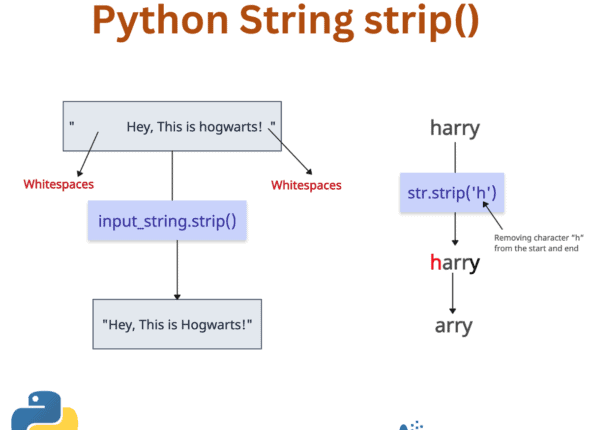
Python String strip() Method
Python strip() is a built-in function that removes any specific characters from a string. By default, it removes any leading…

How to Subtract Two Numbers in Python
The easiest and most efficient way to subtract two numbers in Python is to use the minus (-) operator. Just…

Numpy.exp() Method
The numpy.exp() method calculates the exponential of each element of an input array, returning (e^x), where (e) is the base…

Python List extend() Method
The list.extend() is a built-in Python method that adds all elements from an iterable (e.g., list, tuple, string, set, dictionary…

How to Use Pi in Python
The pi is a mathematical constant whose value is 3.14159, which is used in calculations involving circles, spheres, periodic phenomena,…

How to Sort a List Alphabetically in Python
To sort a list alphabetically in Python, use either the list.sort() or sorted() method. It allows us to arrange string…

Python sum() Function
Python sum() is a built-in function that calculates the sum of all numeric elements in an iterable, optionally starting from…

Python String splitlines() Method
String splitlines() method splits a string into a list, based on line breaks in Python. Line breaks are not included…

What is an inclusive range in Python
In Python, a range is typically created using the built-in range() function, which generates a sequence of numbers that includes…

How to Check If a Variable Exists in Python
To check if a variable exists in Python, you can use scope-specific dictionaries (locals(), globals(), vars()) or exception handling (try/except).…
